FAE Stories
Reclaiming land from invasive vegetation in Australia
Tackling challenging terrain and large-scale vegetation management projects with UML/SSL and PT400
Find out more
Based in the Mid Coast region of New South Wales, Australia, MidCoast Forestry Mulching (MCFM) specialises in forestry mulching and land management, working on private properties, agricultural land, council projects and civil works. Its activities range from creating fire trails and Asset Protection Zones (APZs) to pasture reclamation, invasive vegetation management and large-scale land clearing.
The company started several years ago with compact tracked loaders and forestry mulching attachments, gradually expanding its capabilities with the ambition of investing in a dedicated tracked carrier. Today, its smaller machines operate mainly in the Mid Coast region and surrounding areas, while its FAE PT400 travels across Australia's East Coast to tackle larger and more demanding projects.
 |
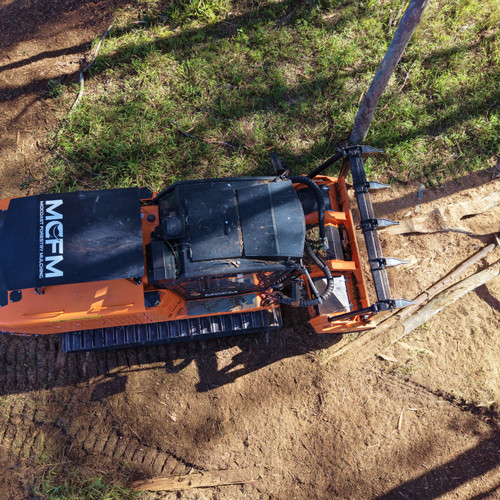 |
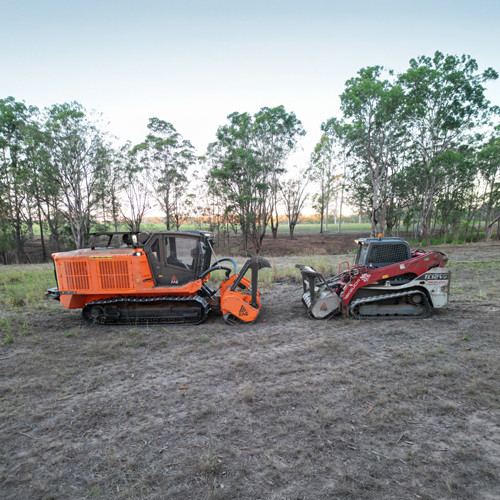
For smaller jobs, generally covering less than 10 acres (4 hectares), MCFM uses an FAE UML/SSL-175 forestry mulcher mounted on a high-flow compact tracked loader. This combination provides the maneuverability and performance required for clearing undergrowth, regrowth and lighter vegetation, as well as selective clearing and pasture reclamation.
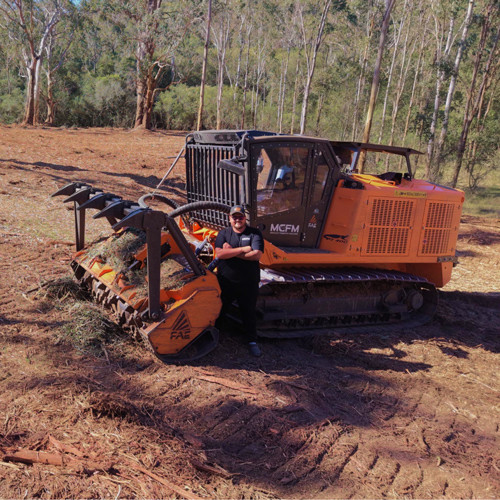
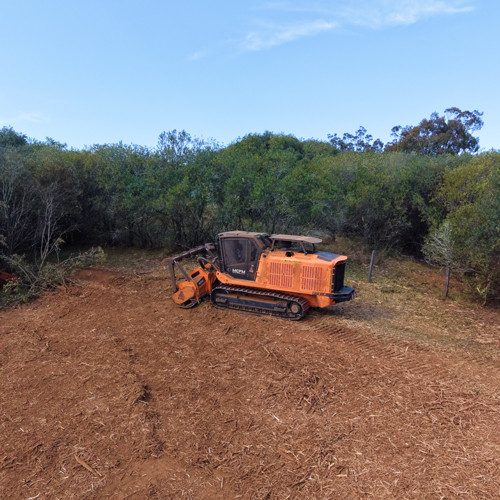
The company's next major step was the acquisition of an FAE PT400 tracked carrier equipped with a 300/U/PT forestry mulcher, giving MCFM the power and productivity needed to manage much larger projects.
“Moving into the PT400 has completely changed the scale of work we can take on,” explains Nathan Puskas, owner of MCFM.
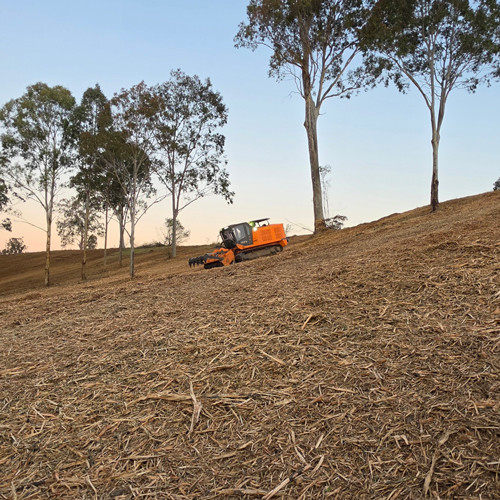
Powered by a 380 hp Cummins engine, the PT400 has already proved its capabilities in particularly demanding conditions. The machine has operated on steep terrain approaching 37°, wet and rocky ground, and sites requiring the removal of mature trees exceeding 60 cm in diameter to reopen paddocks, increase sunlight penetration and encourage pasture growth.
“Whatever we have put in front of it, the PT400 has continued to perform,” continues Nathan.
One of the most significant projects currently being undertaken by MCFM is ”Operation Olive”, a large-scale land reclamation project involving a property of approximately 1,000 acres (405 hectares). Around 500 acres (202 hectares) are heavily infested with African Olive, an invasive species that has overtaken extensive areas of the property.
 |
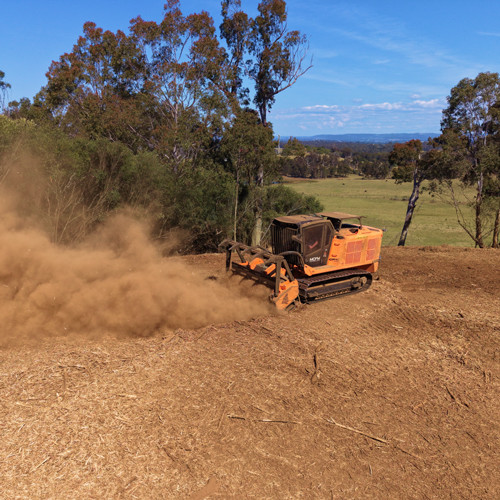 |
It is the densest infestation the company has encountered, with some sections almost completely covered by mature vegetation. The project has been underway for approximately three months, with work taking place across ridgelines, steep hills, rocky ground and areas of exceptionally dense growth.
These challenging conditions are exactly where the PT400 demonstrates its strengths. Its combination of power, stability and high-performance forestry mulching allows the machine to work through extremely heavy vegetation, processing material directly on site and leaving the ground accessible for subsequent land management activities.
The difference in productivity compared with smaller machines has been particularly significant. “On suitable projects, we regularly see approximately three to four times the production of a large compact tracked loader,” explains Nathan Puskas.
The main advantage is the ability to process heavy vegetation continuously, even in conditions that would significantly slow down smaller equipment. This allows the company to cover substantially more ground each day while maintaining the quality of the finished result.
Alongside productivity, build quality and durability have been decisive factors in MCFM's choice of FAE equipment. Before investing, the company spent considerable time researching different solutions and attending demonstrations to evaluate their capabilities.
The experience gained with the UML/SSL-175 has further reinforced that decision. Working in the Australian bush can present unexpected challenges, including hidden debris concealed beneath dense vegetation. Over the years, the company has accidentally encountered old car bodies, engines, refrigerators and other discarded materials while mulching.
 |
 |
Although these are certainly not materials a forestry mulcher is designed to process, the UML/SSL-175 has demonstrated remarkable durability when faced with such unexpected impacts. Its ability to continue operating has given the company confidence in the strength of its rotor, driveline and internal components.
For MCFM, however, productivity and durability are only part of the equation. The quality of the finished work is equally important, particularly when clearing dense vegetation and restoring land for agricultural or other uses. “The finished result is just as important to us as productivity,” Nathan Puskas emphasises.
The company regularly shares its projects online and has received considerable positive feedback from other contractors and industry professionals, particularly regarding the speed at which its FAE equipment processes vegetation and the consistently high-quality finish it leaves behind.
The combination of the UML/SSL-175 and PT400 now allows MCFM to manage projects ranging from selective vegetation clearing on smaller properties to the reclamation of hundreds of acres of heavily overgrown land. The company is also planning to expand its fleet with a 25-tonne excavator equipped with an FAE forestry mulcher, further increasing its capabilities for selective clearing, difficult access and applications requiring greater reach.
Looking back on the company's development and its experience with FAE equipment, Nathan Puskas concludes: “We did a lot of research before making the investment, and FAE stood out to us in build quality, performance and finish. Whether it is our UML175 on smaller projects or the PT400 working through hundreds of acres of dense vegetation, the equipment just continues to perform.”